New Pew Research Reveals Catholicism Remains Latin America’s Largest Religion and 90% Believe in God - with Some Declines in Affiliation
.png)
Today, Catholics make up 46% to 67% of the adult population in each of these countries, while the share of adults who are religiously unaffiliated ranges from 12% to 33%.
In several countries, unaffiliated adults – sometimes called religious “nones” – now outnumber Protestants.
Despite these shifts, Latin Americans remain quite religious, on average. For instance:
- Belief in God is widespread, with around nine-in-ten or more adults surveyed in each country saying they believe in God.
- Religion matters deeply to many people in the region, with about half or more of adults surveyed in Brazil, Colombia, Mexico and Peru saying religion is very important in their lives.
- Prayer is fairly common, with majorities of Brazilian, Colombian and Peruvian adults saying they pray at least once a day.
By these measures, Latin Americans are more religious than adults in many other countries the Center has surveyed in recent years, especially in Europe, where many adults have left Christianity since childhood.
Moreover, Latin Americans are about as likely to believe in God as they were a decade ago. Even among religiously unaffiliated adults surveyed across the region, majorities say they believe in God.
These are among the key findings of Pew Research Center surveys, conducted in spring 2024, that included more than 6,200 adults in Argentina, Brazil, Chile, Colombia, Mexico and Peru.
How has the religious affiliation of Latin Americans changed?
Today, roughly half of Brazilians and Chileans identify as Catholic (46% each in 2024), while Argentina (58%), Colombia (60%), Mexico (67%) and Peru (67%) have much smaller Catholic majorities than they did in 2013-14.
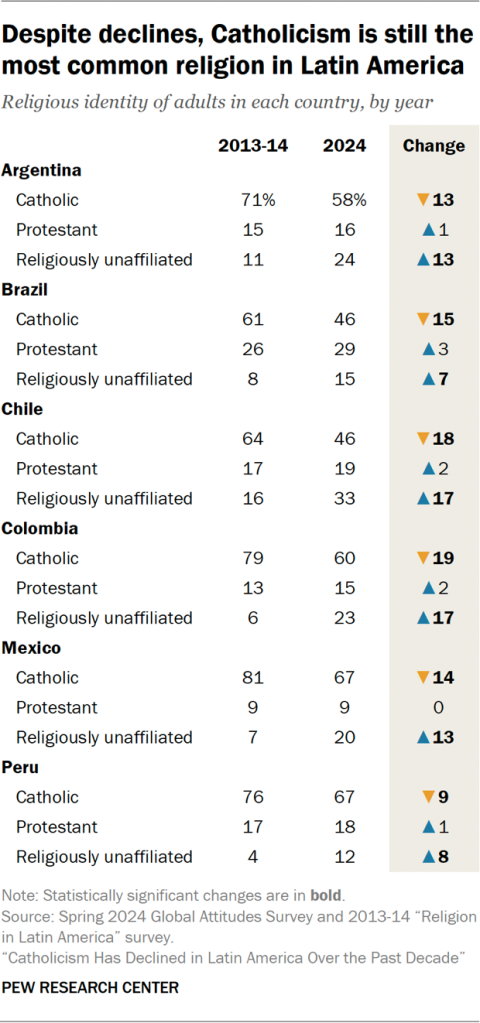
Meanwhile, the share of adults who are religiously unaffiliated has roughly doubled in Argentina (to 24% in 2024), Brazil (15%) and Chile (33%); tripled in Mexico (20%) and Peru (12%); and nearly quadrupled in Colombia (23%).
How religious are Latin Americans today?
Even though Catholics are shrinking and “nones” are growing as a share of the population in every Latin American country surveyed, most adults across the region are religious, to some degree, by a variety of measures.
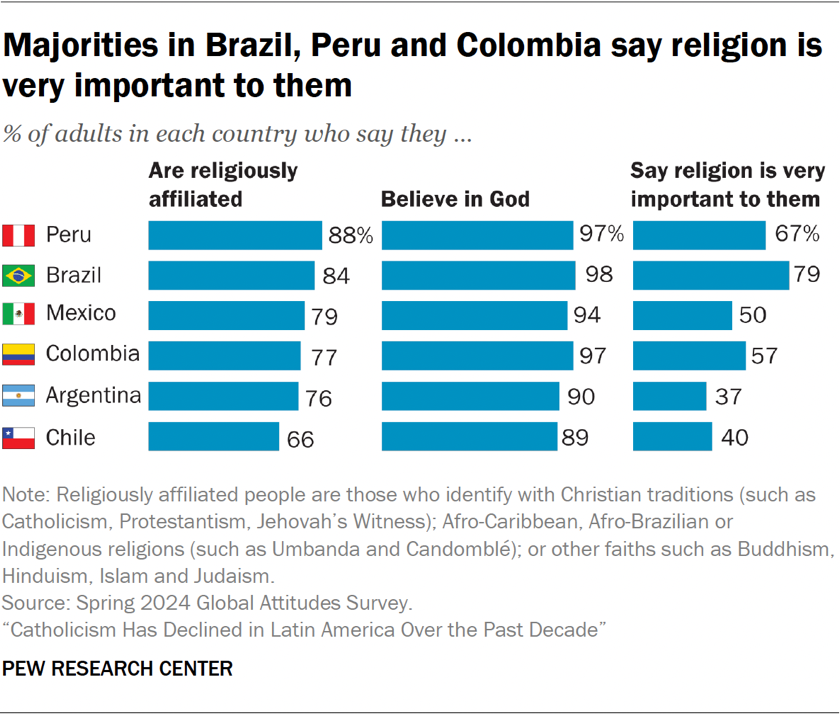
To begin with, in all six countries, most adults identify with a religion. The shares who are religiously affiliated range from 66% in Chile to 88% in Peru. These figures include people who identify with Christian traditions (such as Catholics, Protestants and Jehovah’s Witnesses); Afro-Caribbean, Afro-Brazilian and Indigenous religions (such as Umbanda and Candomblé); and other faiths (such as Buddhism, Hinduism, Islam and Judaism).
Also, the vast majority of adults in every Latin American country surveyed say they believe in God – with percentages ranging from 89% in Chile to 98% in Brazil. Even among religiously unaffiliated adults, majorities say they believe in God. For example, about three-quarters of “nones” in Mexico say they believe in God.
In addition, many Latin Americans regularly engage in religious or spiritual practices. For example, about four-in-ten or more adults in each country surveyed say they pray at least once a day; these shares range from 39% of adults in Argentina to 76% in Brazil.
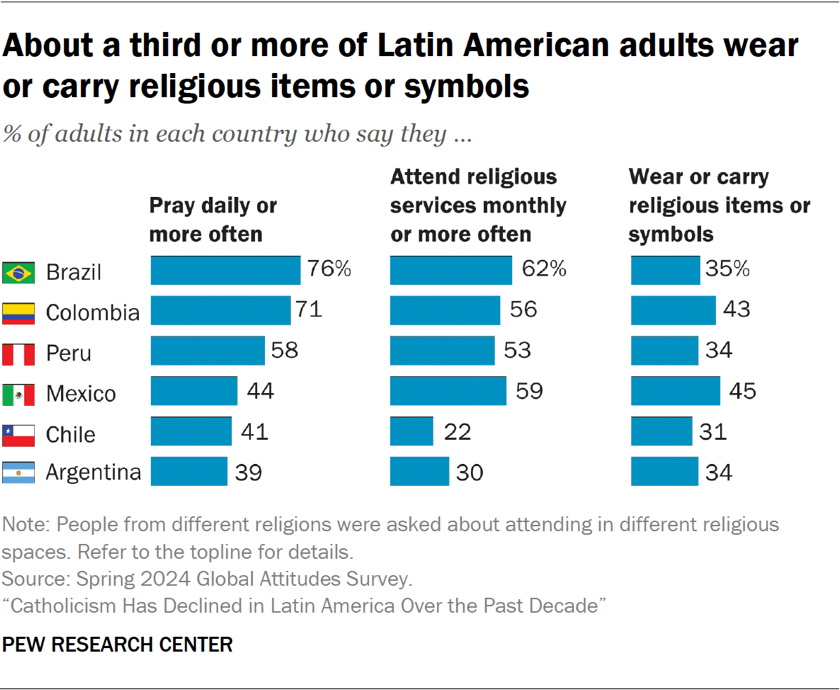
In four countries – Brazil, Colombia, Mexico and Peru – about half or more of adults say they attend religious services monthly or more often. For example, 59% of Mexicans surveyed say they attend religious services at least monthly.
Substantial numbers of adults across the region also say they wear or carry religious items or symbols, ranging from 31% in Chile to 45% in Mexico
Religious and spiritual practices
On the other hand, Catholics are much more likely than Protestants and religiously unaffiliated adults to say they wear or carry religious items or symbols. For instance, six-in-ten Catholics in Colombia say they wear or carry religious items or symbols, while two-in-ten or fewer Colombian “nones” and Protestants say they do this.
Another way of looking at a society’s religiousness is by examining the religious engagement of its “nones” – people who say they are atheist, agnostic or “nothing in particular.”
By these measure,“nones” in Latin America are about as religious as Christians in Europe, on average.3
For instance, anywhere from 58% of Swedish Christians to 92% of Italian Christians say they believe in God. This is similar to the shares of “nones” surveyed in Latin America who believe in God, which range from 62% in Argentina to 92% in Brazil.
When it comes to prayer, a third or more of “nones” surveyed in Brazil, Colombia and Peru pray at least once a day – comparable to the shares of Christians who say they pray daily or more often in several European countries.
And around four-in-ten religiously unaffiliated adults in Brazil and Peru say religion is very important in their lives – similar to the shares of Christians in Greece (36%) and the Netherlands (37%) who express the same view.
Source: https://www.pewresearch.org/religion/2026/01/21/catholicism-has-declined-in-latin-america-over-the-past-decade/
Comments